

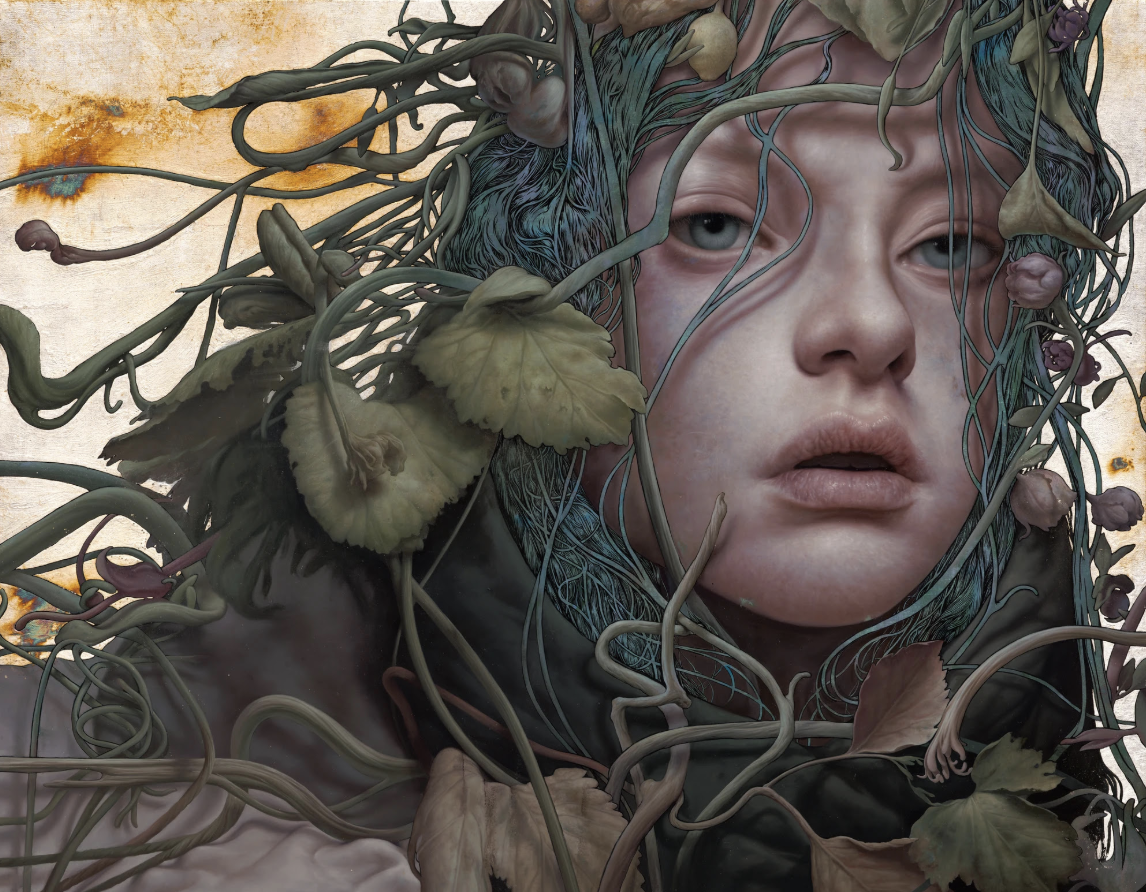
At this year’s presentation at Enlighten Gallery, booth A03, ART TAIPEI 2026, the Taiwanese painter Lo Chan Peng shows a body of work in which the line—once a quiet servant of description—has become a structure of form in its own right. Alongside works by Liou Shiuan Shi, Taisuke Mohri and Naomi Okubo, the booth gathers paintings that ask one of art’s most basic questions: how is a form actually seen?
The line first emerged in Lo’s Homesickness series, where ink, mineral pigment, oil and silver leaf were placed in a single picture and materials from different painting traditions began to work together. In the 2026 works the line moves to the centre. It cuts into the figure’s body, crosses the face and shoulders, and draws hair and vines. Where it meets the modelled volume of the painted face, a boundary appears—one that is not merely decorative but structural.
The gesture carries a long history. In East Asian painting, from baimiao line drawing and ink painting to ukiyo-e, the line carries form directly: a single contour can establish a figure, a plant or running water. When ukiyo-e reached Europe in the late nineteenth century, its contours, flat planes and cropped compositions helped Western painting—long built on perspective, light and shade and volume—admit that the picture is flat. Lo brings this history back into figure painting. He builds the face in oil, layer upon translucent layer, so the skin turns subtly between light and shadow; the hair and vines remain flat, clear contours. Two ways of making form operate on the same figure at once.
For twenty years Lo has painted almost nothing but people. What each painting tries to capture, he writes, is a radiance unique to human beings: being present in time, and accumulating experience in the flesh. That radiance has taken many forms across his career. Strawberry Generation painted the youth of a generation while it was happening. Chronicle of the Human World stripped away setting and props to keep only features and a single gaze—the nameless feeling that stirs when two people look each other in the eye. Historic Movers & the Doomed placed Lincoln, Darwin and Churchill beside the nameless victims of history, their fires burned down to embers. After a great personal loss, Lumière took light itself as its subject; in Firefly, light appears as a faint blinking in the dark that can only be met at the moment it appears. None of these moments can be lived again.
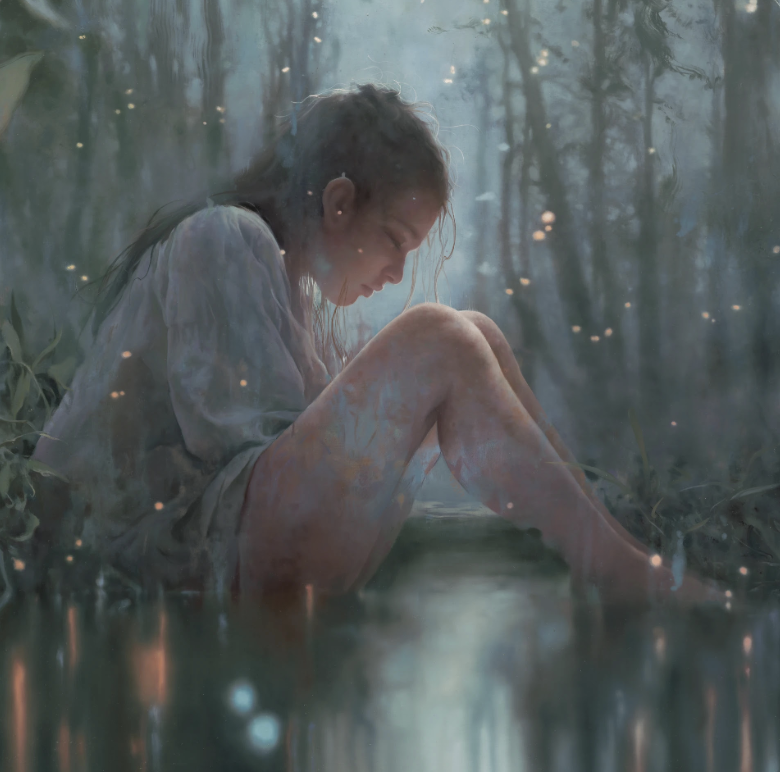
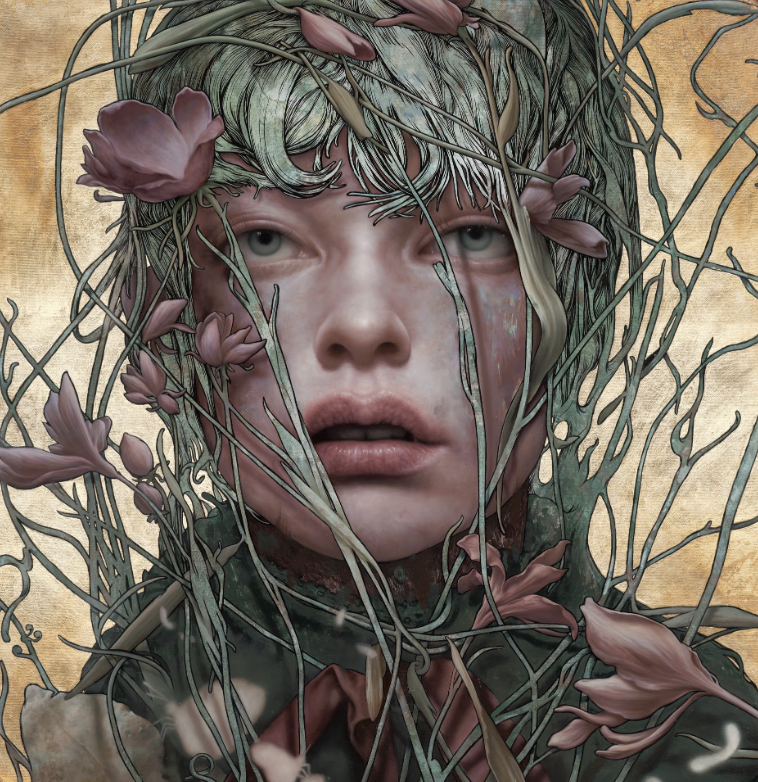
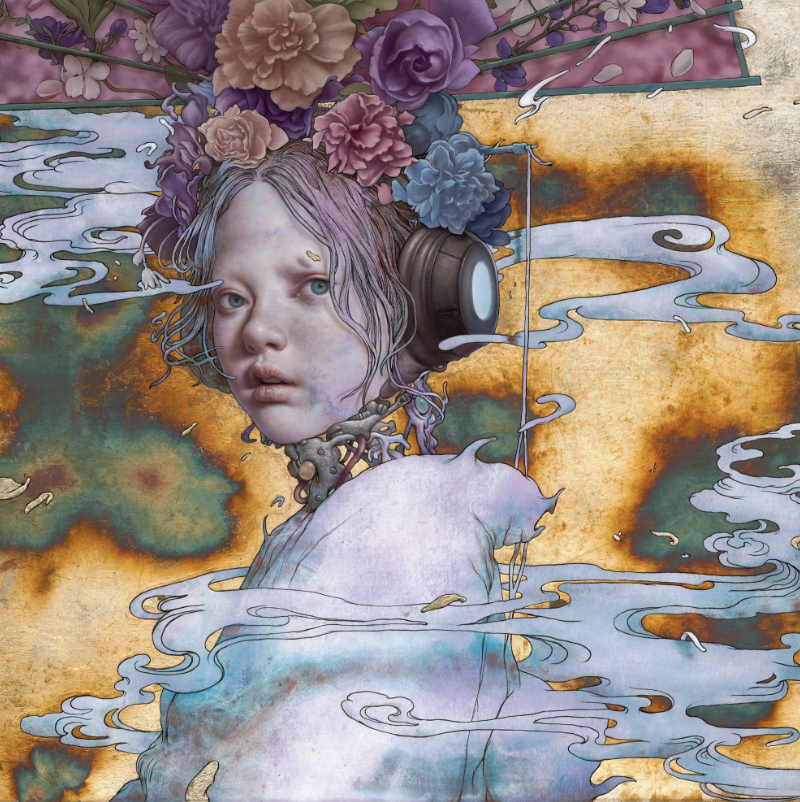
The new works fold this concern into the very structure of the painting. The face is built from translucent layers, each waiting for the previous one to dry completely—a stretch of time passing without a break. The line fixes form in an instant. A life that keeps flowing, and a boundary that lets it take shape for a while, appear together on one face.
The line itself descends from Homesickness (2025), which asked who gets to tell the story called “Asia.” For a long time the continent has been described largely through Western eyes and reduced to an exoticism easy to recognise and easy to collect. Lo paints Taiwan’s version: the contours of ukiyo-e, ink, mineral pigment and burnt leaf entered the island’s culture at different moments in its history, and here they sit in the same picture as realist oil painting. That layered condition, the artist suggests, makes up Taiwan’s own visual experience. The new works start from this mixture and let painting languages of different origins meet on one surface, each keeping its own rules.
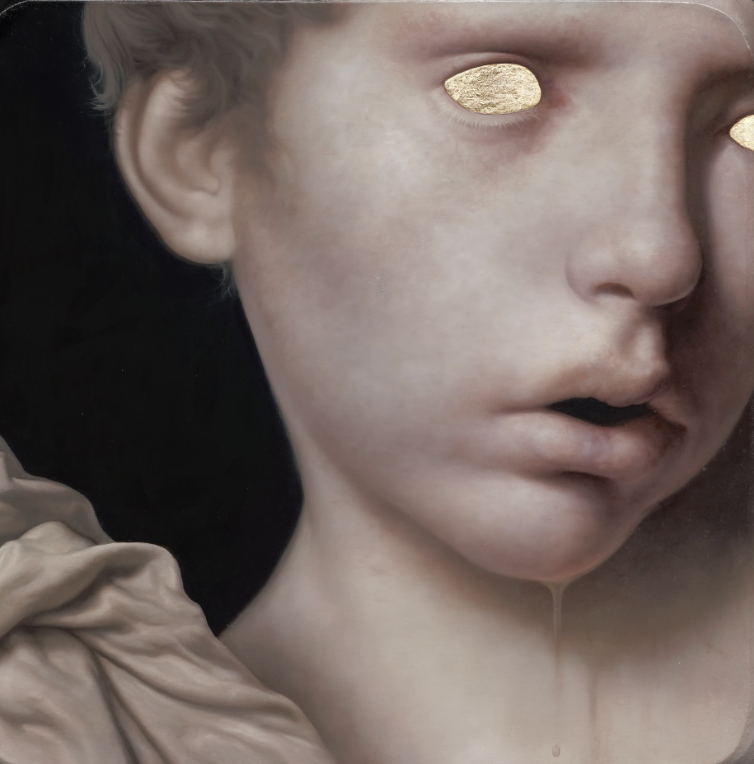
Light enters the new works physically as well. In 2011, Professor Izumi Nakai of Tokyo University of Science analysed Ogata Kōrin’s Red and White Plum Blossoms screens and found silver leaf and sulphur in the stream at their centre. Borrowing the idea of yakihaku, a technique from Japanese painting, Lo fires the silver and copper leaf in his works: heat and chemical reaction cause irreversible colour changes on the metal surface. The artist controls the material, the temperature and the handling—but cannot decide in advance what colour each spot will become, and none of these changes can be redone.
In the series The One Who Remained Still for a Hundred Years, the girl’s face stays in an almost frozen moment while the hair and plants around her keep moving; the metal surface holds a change that has already happened and cannot be reversed. Lo calls his figures “portraits of duration.” History, he writes, lives “in the way a figure remains still after everything has changed.” In a single painting, three senses of time coexist: the figure is still, the line flows, and the leaf keeps a material change already complete.
This carries particular weight in 2026. Images can now be generated, copied and recombined without end in digital space; the colour of burnt leaf can only exist by passing through a real physical process. In his essay “New Values for a New Era,” Lo writes that once a person’s habits of composition, logic of colour and way of thinking can be packaged into an AI agent, “the boundary of the human” will begin to blur. His answer is to return to the outline of a person and, with the slowness of the hand, paint layer by layer the time a life has passed through.
The volume of realism, the East Asian line, the grain of mineral pigment, the translucent layers of oil, and the metal leaf reflecting the light of the room all share one canvas. The viewer’s position becomes part of the work: move, and the reflection on the leaf shifts; change your distance, and the relation between line and volume changes with it. The painting is an image that has been fixed—and a surface that keeps changing as it is looked at.
A sheet of silver leaf reflects today’s viewer and keeps, at the same time, a material change from the past. The light it shows at this moment belongs only to the person standing in front of the painting.
Only in this moment.
Photo credits: Enlighten Gallery
Leave a Reply