

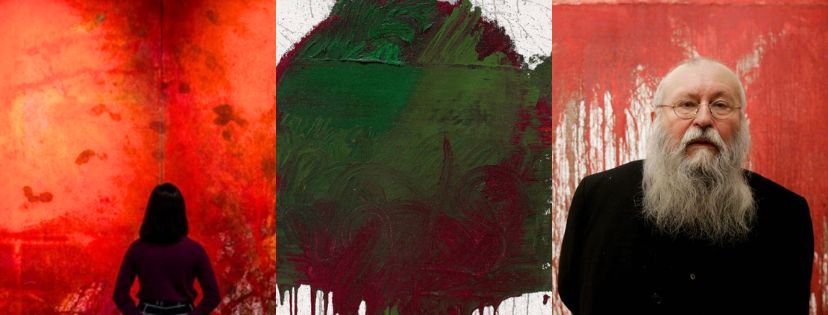
Hermann Nitsch, the Austrian avant-garde artist known for his provocative ritualistic works using blood and animal entrails in explorations of religious, warlike, and metaphysical themes, passed away on April 20, 2022, at the age of 83. “He was for art what Marilyn Manson was for rock music,” wrote Die Welt in his obituary. Four years after his death, the artist’s monumental legacy finds a new home in the hills of Piedmont.
From September 27, 2026, to January 10, 2027, La Crescentina – Laboratorio per l’Arte, nestled in the rolling hills of Monferrato in the province of Alessandria, will host the exhibition Hermann Nitsch: Action and Thought. Curated by Marzia Capannolo with critical contributions by Lóránd Hegyi, and in collaboration with Galleria Umberto Benappi of Turin, the show is dedicated to one of the founding fathers of Viennese Actionism — an artist who transformed art into a visceral, all-encompassing experience, pushing beyond traditional representation to reach a collective rite of liberation.
At the heart of Hermann Nitsch’s lifelong research lies the Theatre of Orgies and Mysteries, a Gesamtkunstwerk — a total work of art — in which the audience ceases to be a passive spectator and becomes an active participant in a secular liturgy. Through the symbolic and material use of blood, flesh, and color, Nitsch weaves together the memory of Dionysian myths, Christian sacrifice, and psychoanalytic catharsis into a primordial celebration of life and death. His iconic Schüttbilder — paintings created by pouring and smearing red pigment onto canvas — transcend their identity as chromatic surfaces to become tangible relics of a sacred action. This aesthetic of excess and sacrality translates into a sensory and synesthetic assault, where the act of painting dialogues with music, food, and the body, jolting modern humanity out of its bourgeois numbness. More than provocation, Nitsch’s work configures itself as a profound, visceral reconnection with the vital and spiritual sap of the earth.
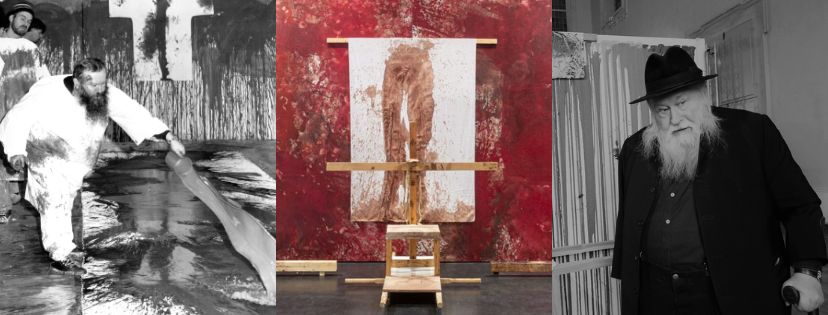
With the exhibition at La Crescentina, the curatorial aim is to create a dialogue between Nitsch’s legacy and the telluric power of Monferrato’s clay-folded landscape. The show emphasizes a chromatic and spiritual superimposition: the liturgical red of Viennese Actionism merges with the brown tones, calcareous marls, and ferrous sediments of the hills surrounding the estate. This is a territory born of passage, the child of a millennia-long metamorphosis shaped by a complex stratification of clays, silts, and limestones that give the local soil and sedimentary rocks their distinctive, evocative gray-blue hue. Nitsch, who frequented these lands and recognized in them the echoes of his own primordial research, is celebrated here through the concept of vital matter, finding in La Crescentina the secular altar for his art.
In this context, the celebrated Theatre of Orgies and Mysteries abandons its purely performative dimension to become landscape. If for the artist the human body is the chosen site of ritual, for Monferrato the “body” is the earth itself — cyclically wounded and regenerated by human labor. The canvases on display thus become maps of a total sensory experience, capable of uniting the sacredness of the aesthetic gesture with the profanity of peasant culture. In this synergy between place and work, Nitsch’s “earthiness” reveals itself not as an absence of spirit, but as its highest expression: a Dionysian celebration of life that rises from mud and blood to become eternal beauty.
La Crescentina is a cultural association founded in 2021 by collectors Fiorella Miraglio and Alessandro Monteforte, with the mission of supporting art and culture through the production of exhibitions, publications, and cultural events — all free and open to the public. Yet the story of La Crescentina begins much earlier, in the relationships Monteforte cultivated between the 1960s and the early 2000s with protagonists of contemporary art, and in the large agricultural building he purchased and restored in the 1980s, turning it into a true cenacle. Today, this venue also houses the Monteforte-Miraglio Collection, curated by Marzia Capannolo, comprising approximately two hundred works including paintings, sculptures, photographs, objects, and design furnishings.
With this posthumous exhibition, La Crescentina invites viewers to rediscover a shared, deep, and fertile belonging to matter — where art, in reference to nature, becomes its most profound and radical voice. Nitsch, who died at 83, left behind a body of work that continues to challenge, disturb, and elevate, finding in the Monferrato landscape a fittingly earthy and sacred resting place for his legacy.
Photo credits: Roberto Serra/Getty Images – Schutterstock – La Crescentina
Leave a Reply