


There is a flash, at the beginning of every revolution. For Caravaggio, it was the discovery that light enters a room like a blade — that the sacred dwells in grimy bodies, that God hides in the faces of drunkards and prostitutes. For Marco Tamburro, born in Perugia in 1974 and now a Roman by adoption, that flash came in the same way — only today, at Palazzo Bonaparte, it tears through the darkness again, transformed, transposed, alive.
Caravaggio Forever, on view from July 16 to August 23, 2026, is not an exhibition about Caravaggio. Nor is it simply an exhibition about Tamburro. It is a confrontation between two eras staring each other in the eye, separated by four centuries and bound by the same urgency: giving form to the truth of man. Curated by Giulia Silvia Ghia, the show presents over forty new works — canvases, archival documents, a documentary by Giovanni Storaro, immersive installations — unfolding across six sections that read as stations of a journey into the human condition.
Tamburro does not quote Caravaggio. He does not imitate or repeat him. This is his most daring move: he does not look at David with the Head of Goliath to reproduce it, but to understand what it means, today, to paint violence with the same courage with which Merisi painted decapitation. As Vittorio Storaro — who has devoted his life to the relationship between light and cinema — writes in the exhibition catalogue, Caravaggio did not paint bodies: he staged the soul through a beam of theatrical, dramatic, living light. And it is precisely there that Tamburro meets him.
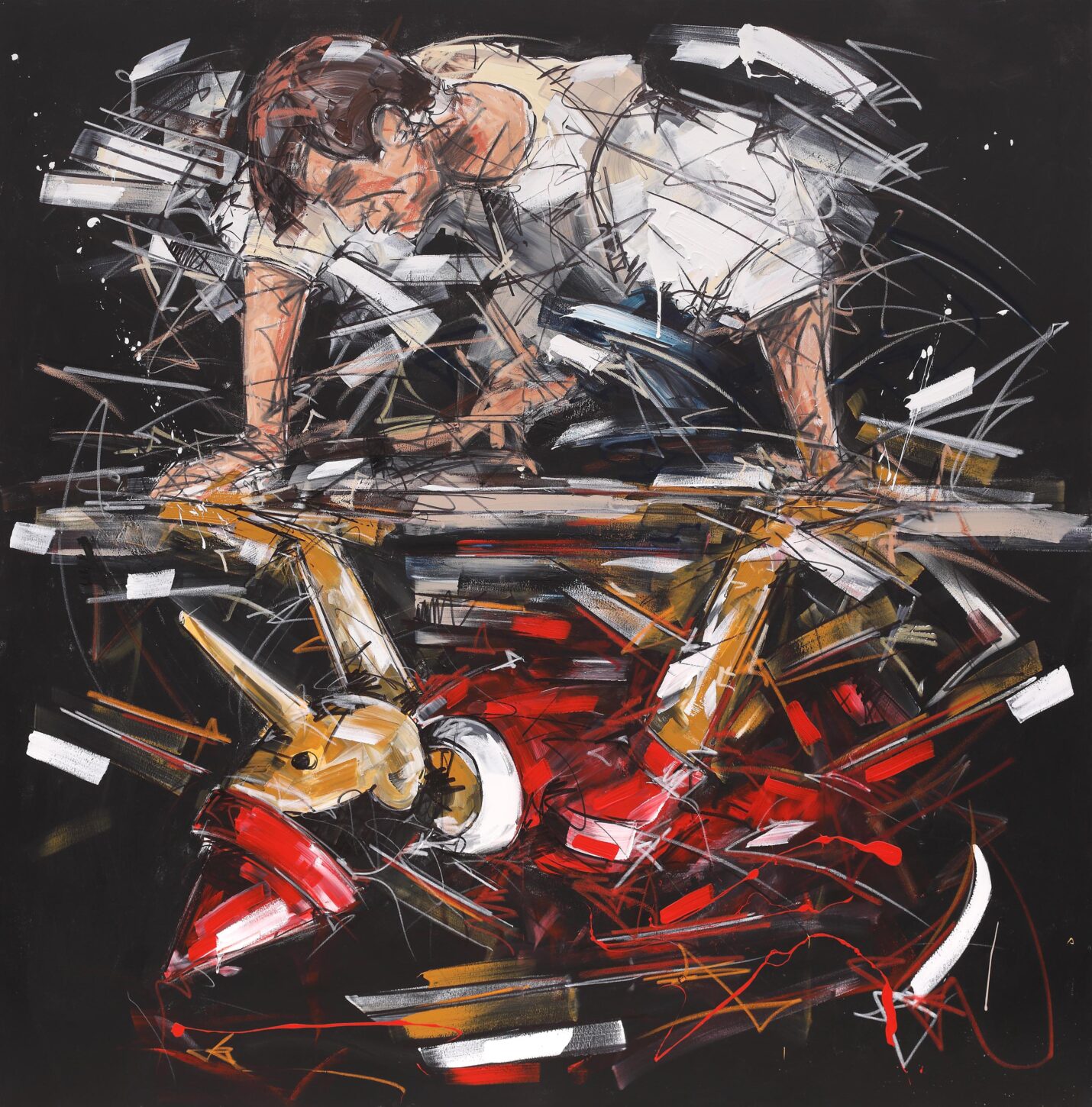
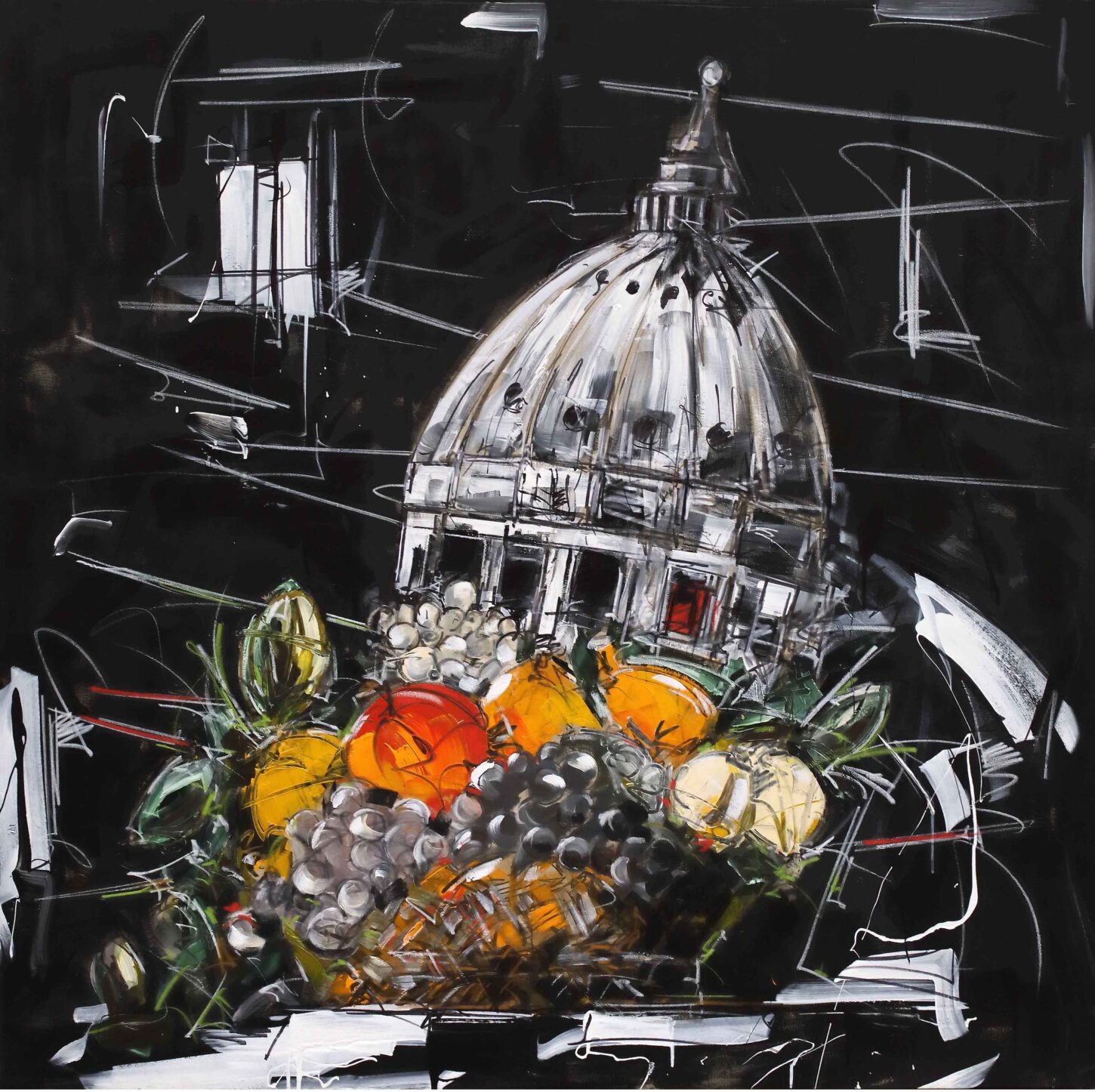

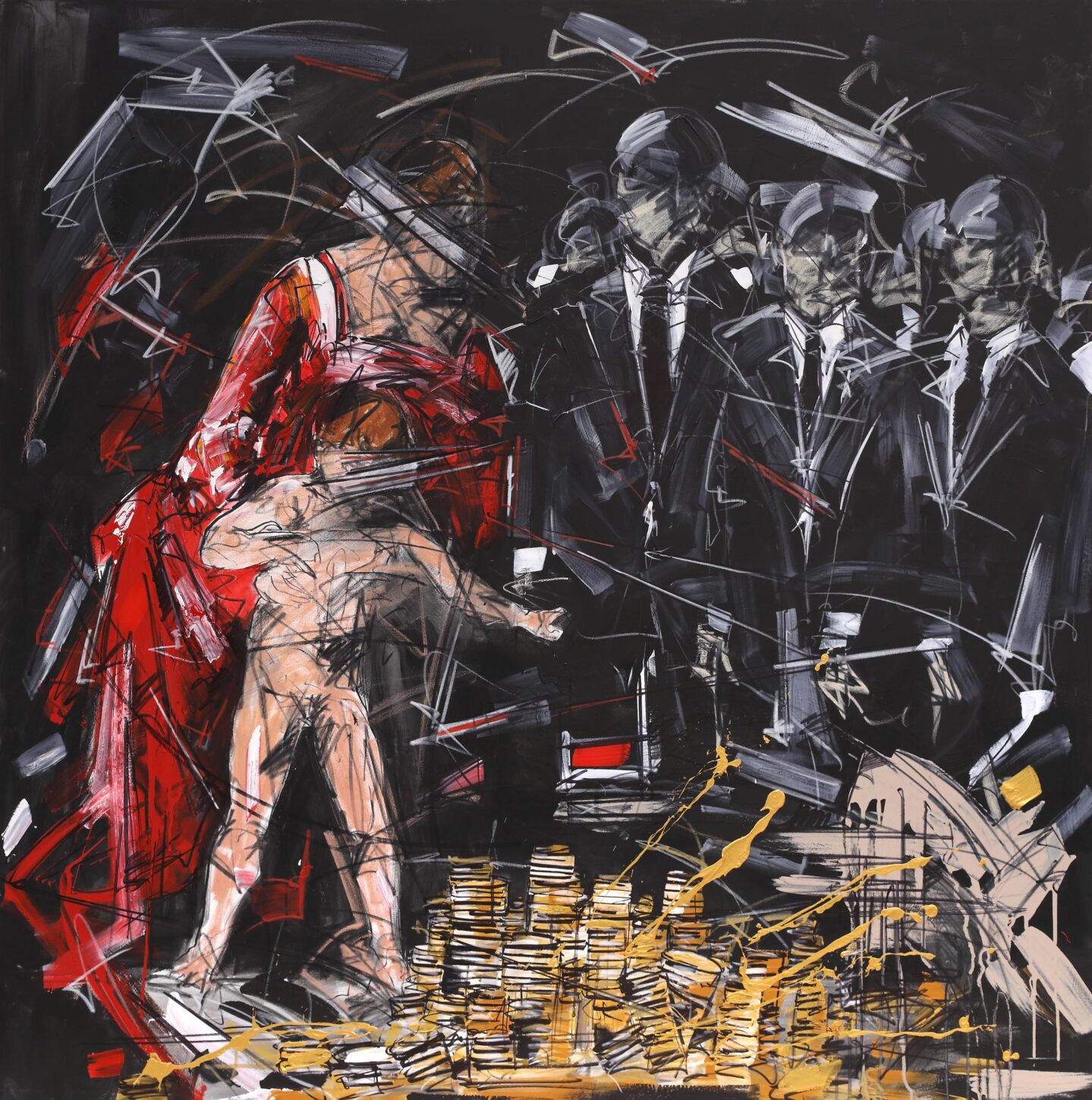
One work in the show, Shakespeare (2025–2026), takes its cue from Caravaggio’s Saint Francis in Meditation. It does not preserve the composition or replicate the gesture. Tamburro takes the tension of that man alone with a skull and translates it into our time: the meditation on death becomes metropolitan solitude; the confrontation with the divine becomes a confrontation with oneself. The same gaze, a different stage. Il pop a Roma, another canvas in the cycle, starts from Judith Beheading Holofernes to speak of power, money, contemporary violence. Holofernes’ head is no longer that of an Assyrian general — it could be anyone, now that we watch the spectacle of violence scroll before our eyes without pause.
amburro’s background is in architecture and set design — a diploma from the Art Institute of Perugia, followed by the Set Design course at the Brera Academy of Fine Arts in Milan (1994), where he began collaborating with photographers and set designers and developed an interest in theatre, and then the Academy of Fine Arts in Rome (1999), where his practice gradually moved from photography to painting as his main medium, chosen to explore themes of everyday life, the loss of values, existence, and the human being. His training shows. His cities are not backdrops; they are emotional geographies, peripheries of the spirit, urban fabrics where light fractures against glass and concrete. Since founding Factory Studio 8 in Rome in 2019, he has turned his studio into a workshop for international exchange, and his works have traveled from the Hermitage Museum in St. Petersburg to the MAXXI, from the Venice Biennale to the Pinakothek der Moderne in Munich, and have been exhibited at venues including MACRO Testaccio — La Pelanda in Rome, Palazzo Medici Riccardi in Florence, Fondazione Sandretto Re Rebaudengo in Turin, and Castel dell’Ovo in Naples. But this exhibition is different. It is the first entirely devoted to his dialogue with Caravaggio, and Rome — the city that saw Merisi’s genius explode and that now hosts Tamburro — is its natural setting.
The exhibition path, designed by BC Progetti, is a narrative experience that goes beyond contemplation. Beside the canvases, a selection of historical documents — from the State Archives of Rome, from the Fondazione Banco di Napoli — reconstructs the system of patronage, relationships, and commissions that made the Caravaggesque revolution possible. This is not a detail for specialists. It is how the exhibition answers the question it starts from: how does an artist change forever the way we see the world? And what does it mean to try, today?

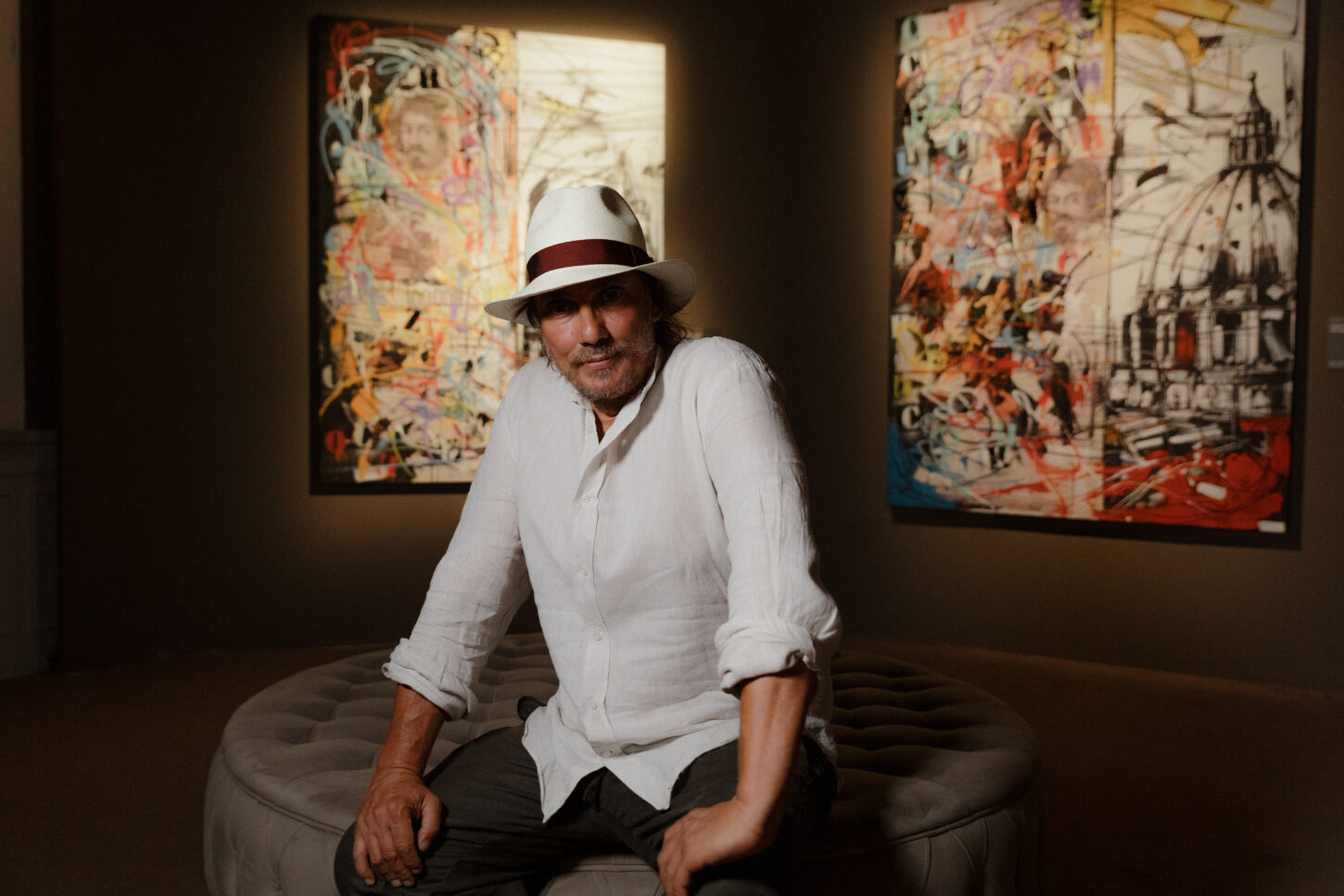
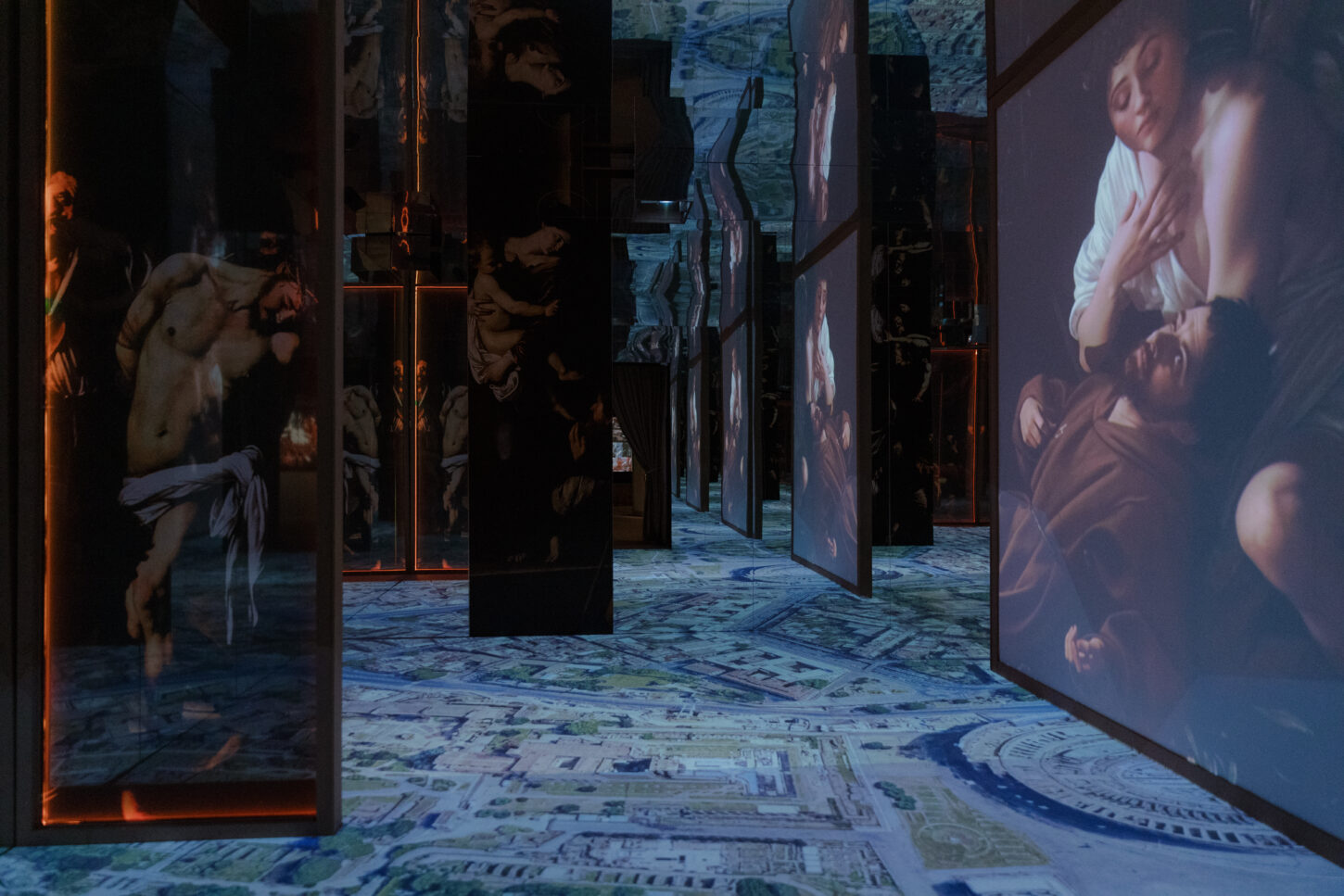
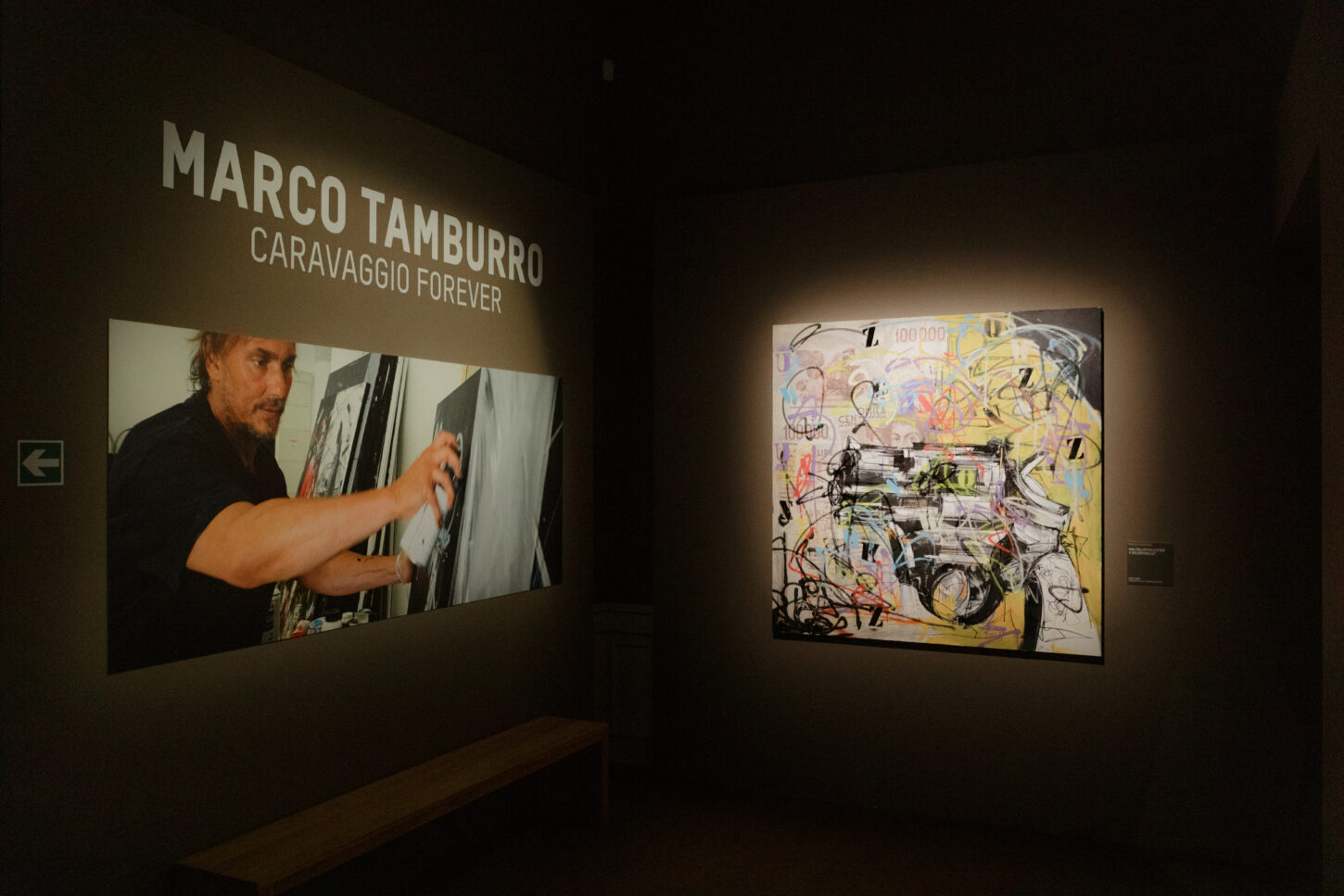
The sixth and final section, Caravaggio in the Collective Imagination, is perhaps the most vertiginous. It investigates how Caravaggio became not only an artist but a universal cultural icon — a brand, even, a myth inhabiting magazine covers, films, advertisements. Tamburro does not judge this transformation: the exhibition lays it bare, sets it in tension with the living matter of painting. Because if Caravaggio is now an icon, he is also and above all someone who continues to speak. Not from the dead, but alive.
That is the point. In Caravaggio Forever, the seventeenth century is not a relic. It is a present tense that has never stopped happening. Caravaggio’s light — that light Storaro calls “cinematographic” — has not been extinguished: it has changed form, entered skyscrapers, suburbs, the faces of the metropolises Tamburro paints with the same urgency with which Merisi painted his street boys. Fragility, desire, solitude, the tension between the sacred and the everyday: they are the same. The clothes change, the phones change, the buildings change. The man does not.
Arthemisia, the exhibition’s producer, continues along the path it has charted in recent years — alternating great classical art with contemporary languages, from Jago to Han Yuchen, from Vincent Peters to Valerio Berruti — in the conviction that understanding the present means knowing how to listen to its most uncomfortable, direct, wounded voices. And Tamburro is all of that: direct, essential, powerfully narrative. His canvases explain nothing. They look at you.
Admission is free. Perhaps that is fitting. Because art that crosses time, as Iole Siena, president of Arthemisia, notes, should not ask for a ticket to enter our lives. It should simply be there — like a ray of light finding the darkness and tearing through it, always, from Caravaggio onward.
Photo credits: © MARCO TAMBURRO. Caravaggio forever. Ufficio Stampa di Arthemisia.
Written by Joanna Longawa
Hashtag ufficiale
#TamburroBonaparte
@arthemisiaarte
@mostrepalazzobonaparte
@marco.tamburro
Leave a Reply