

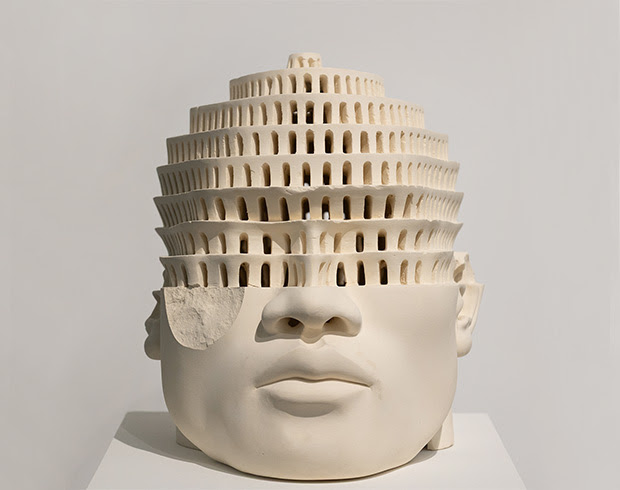
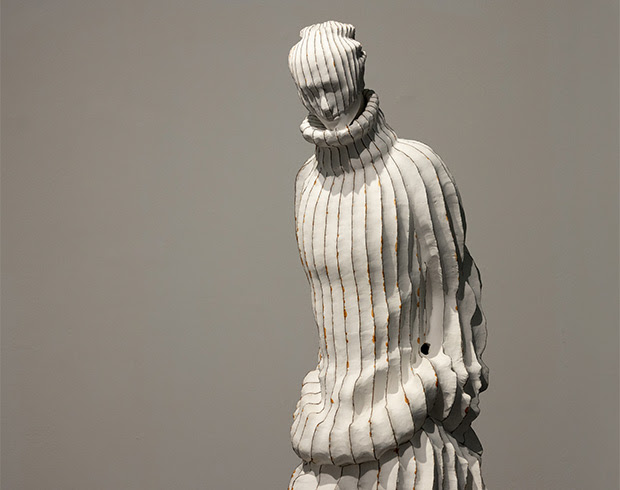
On Saturday 10 October, Galleria d’Arte FABER (Rome) opens BABELE, a solo exhibition by the Japanese sculptor Keisuke Matsuoka, with the gallery open from 10:00 to 21:00 on the opening day.
The exhibition follows Matsuoka’s presentation in the spaces of the Mattatoio in Rome in the winter of 2025–26, and sets out to chart the evolution of the sculptor’s ongoing research. The result is an invitation to immerse oneself in a body of work in continuous transformation — one that nonetheless retains a rigorous coherence and linearity.
Born in Miyagi, Japan, in 1980, Matsuoka graduated and specialised in sculpture at Tohoku University of Art and Design in Yamagata in 2005, and in 2013 was awarded the prestigious government grant “Fellowship of Overseas Study Program for Artists by the Agency for Cultural Affairs, Japanese Government” (USA, 2013–2014). His artistic research centres on an anthropological reflection that underlies his entire body of work, developed through sculptural techniques that are always different and deeply personal. Since 2002 he has exhibited in public museums — among them the RIAS ARK Museum of Art in Miyagi, the National Art Center of Tokyo, the Asago Art Village Museum and The Museum of Modern Art, Gunma — in both Japan and Italy. In 2016 he received a fellowship under the Pola Art Foundation Overseas Study Program, living and working in Rome until 2017 — a period that clearly left its mark on the relationship between his work and the city that now hosts BABELE.
Matsuoka’s entire inquiry develops from deceptively simple questions: What is a human being? What is sculpture? From these he works toward the points of contact that bind every individual, in an effort to sketch out the figure of a universal human. The intense relationship between the artist and the very idea of contemporary sculpture is, in fact, the focal theme of the exhibition.
The works on view summarise the breadth of experimentation of the Japanese artist. Wood, metals, ceramics and the new red waxes are not merely materials to be handled with technical skill; they stand as the codes of a shared language, a means of articulating anthropological, morphological, genetic and spiritual notions. The study of the language that unites us and, at the same time, divides us as a species, evokes the concept of construction and destruction that lies at the core of Matsuoka’s entire oeuvre. In this reading, the recognition of sculpture as a common tongue overturns the canonical interpretation of the myth of the Tower of Babel: it becomes an attempt — and a hope — to identify the threads that connect and bind all human beings.
This trajectory has been recognised with increasing frequency in recent years. In 2019 Matsuoka took part in Art Fair Tokyo 2019 at the Tokyo International Forum, and in the same year exhibited at the POLA Museum Annex in Tokyo. In 2022 he presented the project REFUGEES at Galleria d’Arte FABER and at the Roma Arte in Nuvola art fair; also in 2022 he won the 10th Asago Art Competition and installed his sculpture a tree of elephant at the Asago Art Village Museum in Yokohama, Japan. Between 2024 and 2025 he was awarded the Grand Prize at The OMOTAN Sculpture Award, the Grand Prize at The 85th Kahoku Art Competition, and the Incentive Award at The 18th Kajima Sculpture Competition. In 2025 he presented Keisuke Matsuoka. Le forme dell’umanità at the Mattatoio museum in Rome, the exhibition from which BABELE takes its point of departure.
The installation design brings out the artist’s poetics, foregrounding both its dramatic and its more lyrical aspects: at times isolating individual sculptures, at times gathering them into compositional series, and elsewhere surprising the viewer with abrasive, wall-mounted explosions. As Matsuoka himself puts it: “I have the sensation that destruction and creation are two sides of the same coin, and that beauty lies precisely at their boundary.”
BABELE is curated by Cristian Porretta.
Photo credits: Galleria d’Arte FABER
Leave a Reply